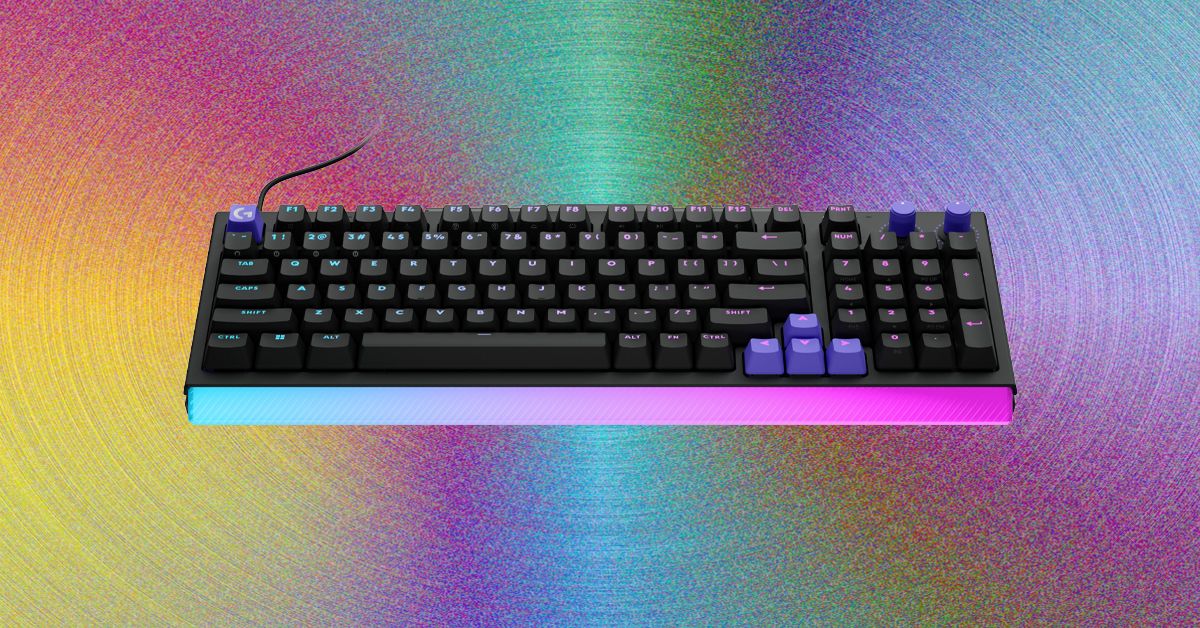
The transition from analog switches back to mechanical isn’t perfect, either. When you plug in a normal switch and press the “scan” button to reset the board, the multi-input functionality still stays semi-functional. In my testing, where I set a WASD half-press to be the normal letter, and a full press to be [Shift + WASD], pressing any of those keys and a second key immediately after would cause the next input to combine with the Shift input, resulting in wOrdS with raNdOMly capitaLized letters! The strangest part is that the G-Hub app knows when a mechanical switch is plugged in, and gives you an alert that the multi-input won’t work with a standard switch, but it doesn’t default to the key’s standard input to avoid issues.
The tedium of swapping out switches, scanning, and changing keymaps every time you start up a game is not ideal. I found myself groaning at the prospect, and using only the mechanical switches for gaming. Much like glasses with transition lenses, the BMW i8, or a McRib, this keyboard creates a hybrid version of two things that is, across the board, worse than its individual parts.
One nice touch is that the removable angled feet on the underside of this keyboard also function as keycap and switch pullers. If you’re traveling with this keyboard, you’ll always have these tools with you. But it also means, if you don’t like using your keyboard at an 8-degree angle, you’ll have awkwardly-designed switch and keycap pullers sitting on your desk. The mild added convenience of part-time storage is nowhere near as practical as the standard flip-out feet and separate keycap/switch puller that most keyboards today include. It’s also not as practical as Steelseries’ silicone flap to hide a keycap puller.
Internal Assembly

Photograph: Henri Robbins
If you’re expecting a keyboard of this caliber to have a complex internal assembly, you’re right on the money. Taking it apart involves removing the bottom feet and the back sticker, removing a few screws, removing the back panel, unscrewing another dozen screws, then separating the front and middle sections, after which you’re left with four major components: The top shell, the main assembly of the PCB and plate,, the middle shell (which houses the LED bar, along with the daughterboard housing the USB-C port back buttons), and the bottom shell. While disassembly is fairly lengthy, I actually quite like the assembly. Besides the adhesive feet, everything seems incredibly rigid and well-designed internally. The only real improvement would be replacing the plastic screw posts with heat-set metal threads.