
Photograph: Chris Null
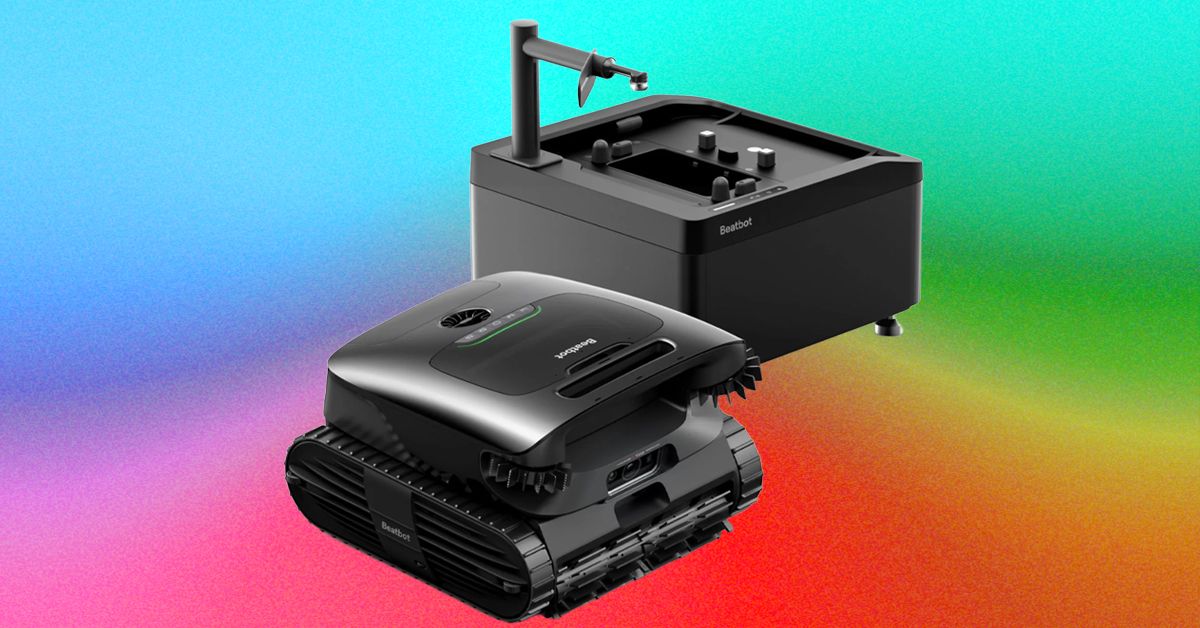
Naturally, the AstroRinse also needs a power supply, so if you don’t have a standard electrical outlet near your hose spigot, you’ll need another extension cord solution here. The unit must be level to run properly, and it features adjustable feet and a built-in spirit level to help you achieve that.
All told, you’ll need to carefully consider where you’re going to place the AstroRinse, ensuring you have access to water, power, and drainage—and that the location isn’t too far from the pool. Since the AquaSense X robot itself weighs 29 pounds (and more when freshly pulled from the water), you probably don’t want to haul the thing halfway across the yard to clean and charge it. Unfortunately, given the availability of the above three services in my backyard, that’s exactly what I had to do.
A Familiar Friend in the Water
The Beatbot AquaSense X robot is nearly identical in appearance to the Beatbot AquaSense 2 Ultra except for some changes to the basket design (which is a single piece here instead of two). Setting it up is far simpler than the AstroRinse.
Physical configuration involves installing two side brushes—these are used only by the skimmer function—but this is a fairly quick affair. Once the brushes are attached, the robot must be set on top of the AstroRinse cleaner so the two devices can be wirelessly paired together. (The quick start guide lays out the particular button presses you must do to complete this process; don’t lose it.) Lastly, the system must then be paired to the Beatbot mobile app; you’ll need Bluetooth and a 2.4 GHz or 5 GHz Wi-Fi connection to complete this task. One tiny hiccup I encountered: After completing all this work, both devices downloaded firmware updates, which promptly broke their pairing connection. It was easy to reestablish, however, by simply repeating the pairing process.
Video: Chris Null
After a full charge, I put the cleaner through its paces in the pool on both the floor and the surface, and as expected, I saw no real difference in performance against the AquaSense 2 Ultra. During floor testing with both organic and synthetic debris, the device picked up an average of 97 percent of the test material, doing exceptionally well on steps and platforms. On the surface, the unit was predictably middling to awful, collecting less than half of floating debris and sinking most of the rest. The unit is just too slow to collect much material on the surface, even though its spinning side brushes help, to a small extent, to pull leaves into its maw.
On the floor of the pool, maximum running time is about 41/2 hours, courtesy of a 13,400 mAh battery—the same as the battery on the AquaSense 2 Ultra.

ScreenshotBeatbot app via Chris Null
As with other AquaSense robots, a bevy of operating modes are available in the Beatbot app, letting you choose from dozens of potential combinations of floor, wall, waterline, and surface cleaning, each with up to two runs per zone and with various running times. An AI Quick Mode activates the onboard camera to allow the robot to actively search for debris instead of encountering it randomly; it’s good for a quick clean when there’s not much to pick up but more than you can easily fetch with a net.
Again, not much of this is any different from how the AquaSense 2 Ultra behaves, and aside from the poor surface performance, it works outstandingly well.
Charging and Cleaning
On to the main event: cleanup. After each run, the AquaSense X parked itself at the waterline to await retrieval, and I dutifully lugged it across the pool deck to where I had the AstroRinse station set up. While it can take a little trial and error to get the robot seated in just the right spot, once you do, the cleaning system kicks in automatically within a few seconds.
Video: Chris Null
As the rinsing system starts up, the top-mounted arm swings into place and connects with the mouth the robot uses for surface skimming. Then, a high-pressure stream of water (sounding quite loud) begins blasting from the arm and into the filter basket, which is positioned directly below this opening. The water spray runs uninterrupted for three minutes before the arm swings back and the system shuts off. (A quick mode, which runs for one minute, can also be selected in the app.) After that, the arm retracts and the unit is done. Debris is captured in a net-covered basket built into the base of the cleaning station. Any remaining water drains out through a mesh screen at the very bottom of the unit.

Photograph: Chris Null