
Key Takeaways
- Apple sued OpenAI on July 10 in California federal court, naming hardware chief Tang Tan in a 41-page filing.
- Apple says ex-engineer Chang Liu kept a company laptop and pulled confidential files after joining OpenAI in 2026.
- OpenAI denies the claims as it readies its first device for 2026 and a potential IPO near an $852B valuation.
Two Tech Behemoths Collide
The lawsuit, filed Friday in federal court, alleges OpenAI orchestrated a scheme to obtain Apple’s product designs, manufacturing processes and supply chain strategies as the AI firm builds its first consumer hardware device. The complaint states:
At every level, from members of its Technical Staff to its Chief Hardware Officer, and in coordination with business partners, OpenAI has been stealing Apple’s trade secrets and confidential information.
Elsewhere, the filing argues OpenAI’s hardware business now “rests on the shakiest of foundations, rotten to its core by its illegal reliance on misappropriated trade secrets.”
Two Names at the Center
Tang Tan, OpenAI’s chief hardware officer and a 24-year Apple veteran, allegedly used Apple’s confidential project code names while recruiting, directed candidates still employed by Apple to bring hardware components to their interviews, and coached departing employees on evading Apple’s security procedures. Chang Liu, a senior systems electrical engineer who spent eight years at Apple, allegedly failed to return an Apple-issued laptop after joining OpenAI in 2026 and used the machine to download confidential technical documents.
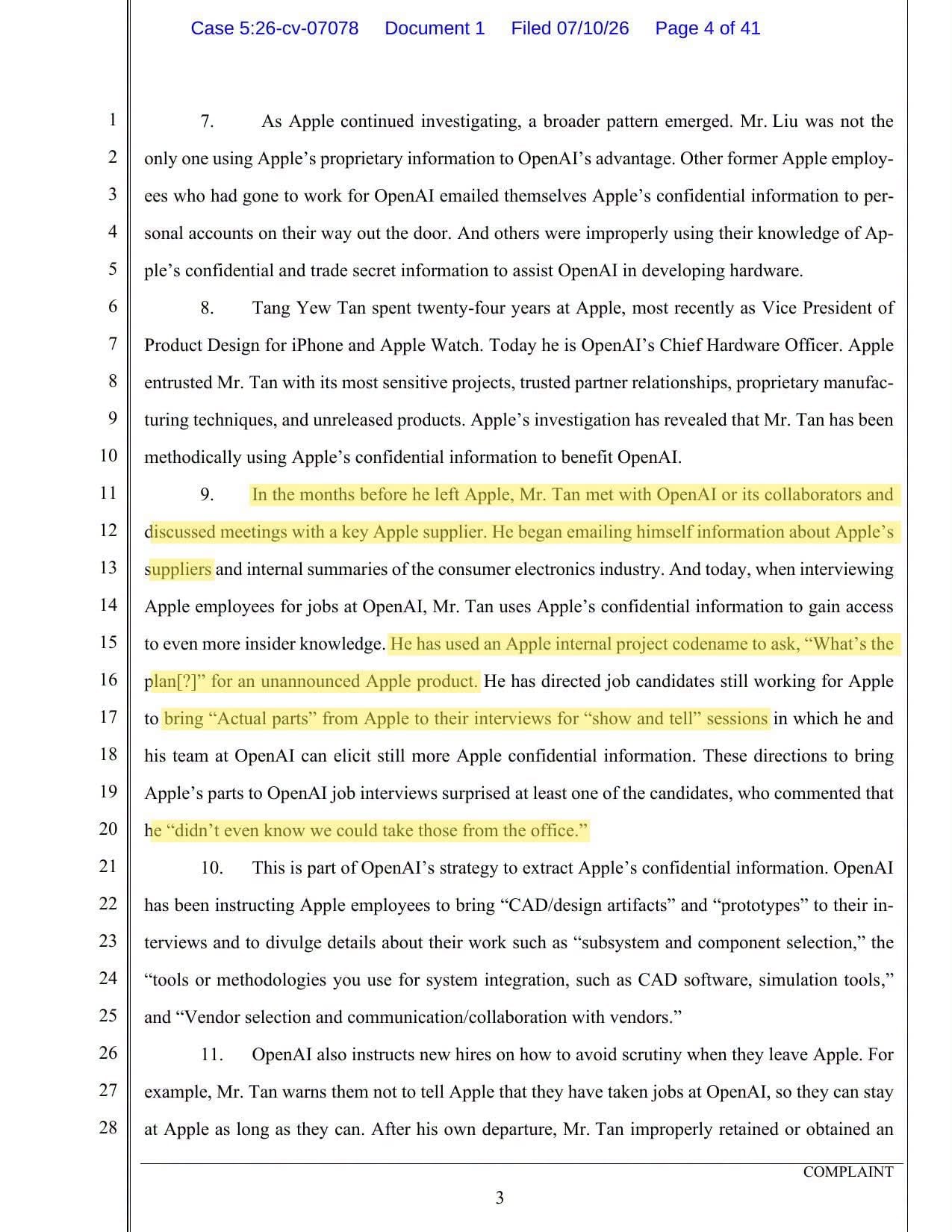
The stolen material cited includes technical specifications, engineering presentations and a proprietary metal finishing technique that Apple claims was misused in OpenAI’s hardware development. Apple is asking the court to bar OpenAI from using the trade secrets, force the return of confidential materials and preserve evidence.
From Partners to Adversaries
The clash comes as a complete 180 degree turn from 2024, when the two companies struck a landmark deal to integrate ChatGPT into the iPhone’s operating system. Relations cooled after OpenAI bought io Products, the device startup founded by former Apple design chief Jony Ive, for $6.4 billion in May 2025 (and confirmed plans to ship its first physical AI device in 2026).
OpenAI pushed back on the allegations, explicitly stating:
We have no interest in other companies’ trade secrets. We remain focused on building innovative technology that empowers people everywhere.
The suit lands at a delicate moment for OpenAI beyond the courtroom. The company is widely expected to pursue a public listing in the second half of 2026, with private funding rounds valuing it around $852 billion, part of an initial public offering (IPO) wave that some analysts argue could pull capital from bitcoin and other risk assets as investors chase AI exposure. No hearing date has been set.
