Key Takeaways
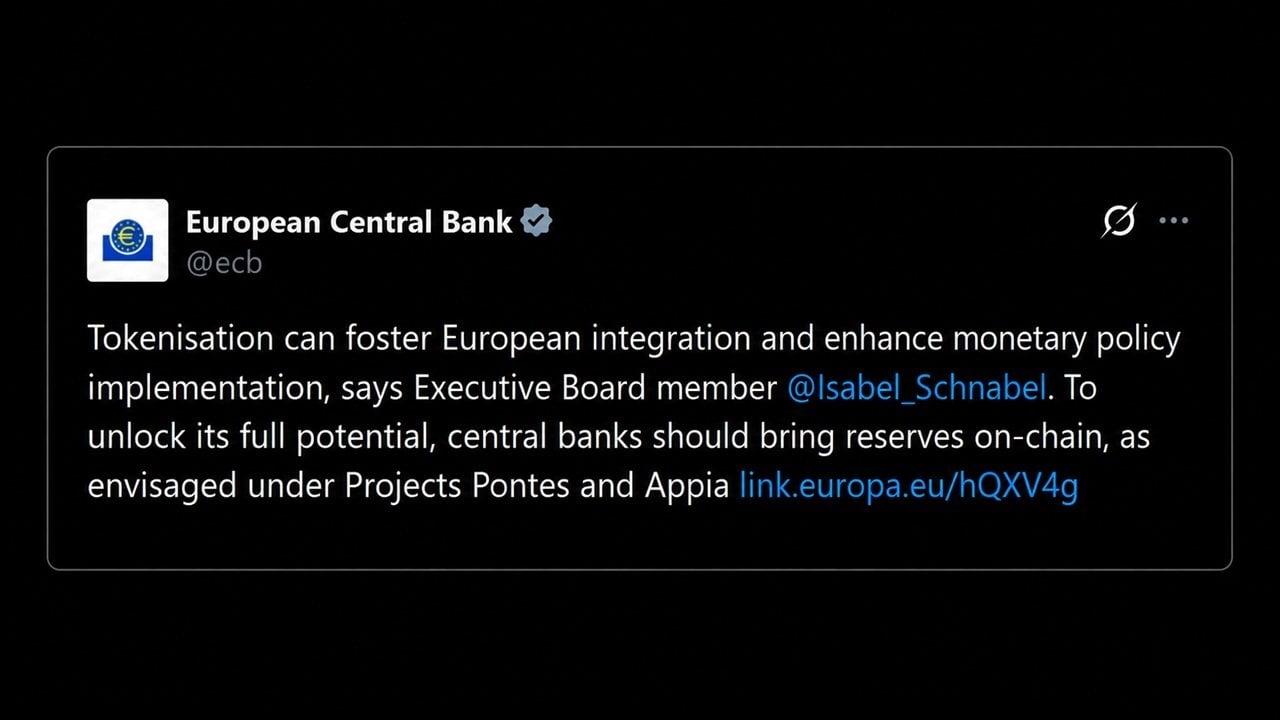
- Isabel Schnabel believes that the ECB must bring its reserves onchain.
- Project Pontes is due to launch in September 2026, syncing TARGET Services with DLT platforms.
- Project Appia targets a full tokenized-market blueprint for Europe by 2028.
Schnabel’s Pitch
Isabel Schnabel didn’t mince her words, stating unequivocally that stablecoins lack “the independent capacity to expand liquidity rapidly during periods of financial stress,” a gap only a central bank can fill.
Her solution seems rooted in tokenization, adding that the technology can make financial transactions faster, safer, and more programmable, but only if the safest asset in the system (à la central bank money) actually lives on the same rails as everything else being tokenized.
That’s a notable admission from inside the Eurosystem because for years, European Central Bank officials treated distributed ledger technology (DLT) as something to regulate around stablecoins and crypto markets, not infrastructure to adopt directly.
Project Pontes Lands First
The near-term piece of this scheme is Project Pontes, which the ECB expects to launch in September. Pontes will initially synchronize the ECB’s existing TARGET Services (the payment infrastructure eurozone banks already use to settle euro transactions) with DLT platforms run by market participants.

Over time, Schnabel said, Pontes is designed to support settlement finality directly on a Eurosystem-operated DLT platform, complete with smart-contract functionality and, eventually, 24/7 operation.
News.bitcoin.com reported in March that the European Central Bank had already outlined an extensive roadmap, with Pontes’ executive board member Piero Cipollone posturing the goal as building “a single digital financial market to stand alongside” the euro itself.
Appia Is the Long Game
Where Pontes is the bridge, Project Appia is the destination. Appia is tasked with mapping the longer-term architecture, technical standards and legal framework a genuine European market in tokenized assets would need, with a full blueprint expected by 2028. The two-year runway reflects how unresolved the underlying questions still are.
That said, trials testing interoperability between DLT platforms and existing settlement rails have processed roughly 1.6 billion euros across 64 participants in nine jurisdictions, and European issuers have placed nearly 4 billion euros in DLT-based instruments since 2021. Since March 2026, the ECB has also accepted DLT-based assets as eligible collateral for its own credit operations.
Why This Extends Past Europe
None of this directly sets bitcoin’s price, but it lands in a market where institutions are already using blockchain rails to move trillions in tokenized value, and where every signal that a G7 central bank is willing to settle its own money onchain adds legitimacy to the infrastructure crypto markets have run on for over a decade.
If the ECB (an institution built to be conservative about monetary plumbing) is racing to avoid being “disintermediated” by private tokenization, it’s a reminder that the debate crypto traders track through bitcoin’s price and stablecoin volumes is the same one now playing out inside central bank boardrooms.